The Long Watch: A December Observational Calendar for Orchids
December is not, on the face of it, a month for growth. The light is thin, the rooms are warm, and the windowsill becomes a contested space of candles, cards and the occasional paper star. Yet for the indoor orchid grower, the shortest days offer something unexpectedly valuable: a reason to slow down and look properly. An Advent calendar of sorts, perhaps, though the doors open onto observation rather than chocolate.
The practice set out here is deliberately modest. It is not a schedule of interventions, nor a promise that a tired Phalaenopsis will bloom by Christmas. It is a four-week discipline of small attentions — a daily glance, a weekly check, a considered arrangement — that keeps the grower connected to the plant without asking the plant to perform.
The case for a slower countdown
Orchids are often treated as objects to be maintained: watered on a rota, fed on a schedule, moved when they fail to please. December rewards a different approach. In low light, most indoor orchids are not pushing growth with any vigour. Roots may be resting, leaves may be slower to unfurl, and flower spikes — if they come at all — are usually the result of conditions established weeks or months earlier. The grower’s task is therefore less about doing and more about noticing.
A daily two-minute pause is enough. Stand in front of the plant. Look at the leaves, the roots visible at the rim, the surface of the compost, the position of the pot relative to the glass and the radiator. Note one thing. It might be a new root tip, a dulled leaf, a draught from a sash window, or simply the fact that the plant has not changed at all. Over twenty-four days, this small record becomes a portrait of the plant’s winter temperament.
A weekly rhythm rather than a daily task
It is tempting to turn an Advent practice into a to-do list. Resist that. The useful work of December can be gathered into four weekly anchors, with the daily observation left free of obligation.
First week: light and warmth. Check where the plant is standing. December light is weak even at a south-facing window, but it is still better than the middle of a room. Move orchids closer to the glass if there is no risk of cold draughts or scorch from a low sun. At the same time, lift them away from radiators, hot pipes and the warm updraught of a television. A cool, bright position is generally kinder than a warm, dim one.
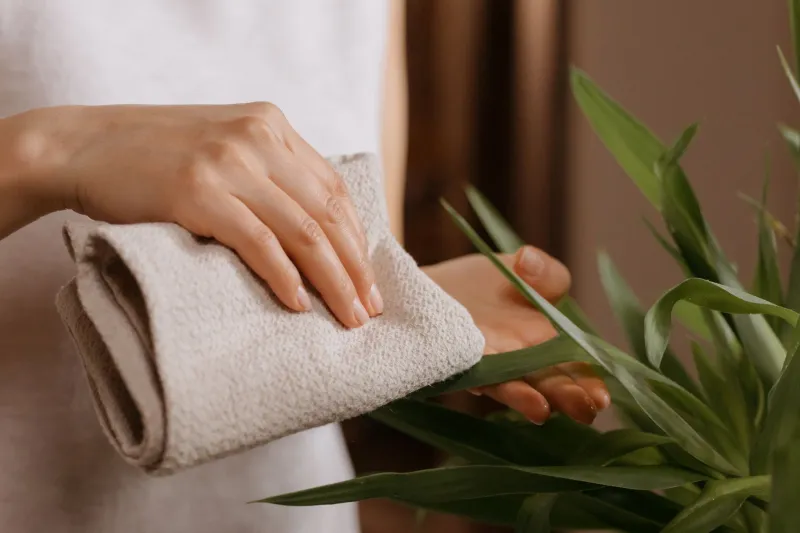
Second week: leaves and undersides. Dust settles on broad orchid leaves, and December rooms are dustier than we think. Wipe leaves gently with a damp cloth, supporting each leaf from beneath. Look at the undersides for scale, mealybug or the fine webbing of spider mite. Do not use leaf-shine products; the natural sheen is enough. A clean leaf captures what light there is.
Third week: roots and compost. If the orchid is in a clear pot, look at the roots without disturbing them. Silvery roots suggest thirst; green roots suggest recent watering. Judge the compost by touch rather than by calendar. In cool December conditions, a plant may need less frequent watering than it did in October. Water in the morning, using room-temperature water, and let the pot drain fully. In hard-water areas, rainwater or filtered water remains the kinder choice.
Fourth week: display and restraint. If the plant is to form part of a festive arrangement, keep the arrangement simple. A single stem, a clean pot and a low bowl of moss can be more elegant than a crowded centrepiece. Keep orchids away from bowls of ripening fruit, which release ethylene, and away from the direct heat of fairy lights. Water before the plant is dressed for the table, not afterwards, so that no water sits trapped around the collar.
What the leaves are saying
December is a good month to learn the language of leaves. A limp leaf may mean thirst, but it may also mean cold roots or a compromised root system. A yellowing lower leaf on a Phalaenopsis is often ordinary senescence; yellowing across several leaves in mid-winter is a reason to inspect the roots and the compost. A puckered leaf suggests water stress. A leaf with a dry, papery tip may reflect low humidity or mineral accumulation in the compost.
None of these observations require immediate action. The discipline is to note them, wait a few days, and see whether the plant is simply adjusting to the season. Orchids are slow communicators. December gives us permission to be slow listeners.
Roots at the rim
For growers with clear pots, the roots are the most honest part of the plant. In winter, healthy roots may look less plump than they did in summer. That is not necessarily a problem. What matters is the colour and the firmness: green or silvery-green roots that are firm to the touch are doing their work. Brown, mushy roots at the base of the pot suggest overwatering or stale compost. Dry, papery roots suggest the plant has been kept too dry for too long.
If the compost has broken down into a dense, sour-smelling mass, plan a repot for spring rather than attempting it in the darkest weeks. December is for assessment, not surgery.
A festive setting that leaves room to breathe
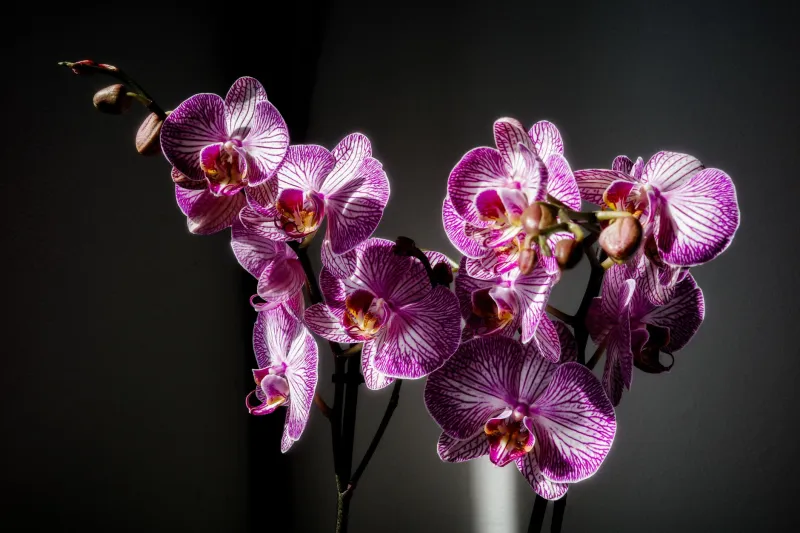
There is a particular pleasure in an orchid displayed at Christmas: a clean white Phalaenopsis against dark green foliage, a single Paphiopedilum on a sideboard, a small Cymbidium in a cool porch. The key is to treat the plant as a living thing rather than a decoration. Keep the display away from the fire, the radiator and the front door’s draught. If the orchid is wrapped, ensure the collar and roots are not sealed in plastic or pressed against a cold outer pot. Moss should be damp, not sodden.
A simple arrangement of one orchid, a few stems of ivy and a plain ceramic pot will often look more considered than a crowded table. The plant needs air around its leaves and drainage beneath its roots. Beauty and breathability are not opposites.
The final week
By the last days of December, the daily observation may have become a habit. The notes may reveal that the plant has barely changed — and that is a useful result. It means the orchid has been kept steady through the darkest weeks, neither pushed nor neglected. If a flower spike is forming, resist the urge to stake it too tightly or to move it repeatedly. Let it find its own line.
On the twenty-fourth day, water if the compost is dry, wipe the leaves, and leave the plant where it is. The countdown ends, but the practice does not need to. January will bring stronger light and, eventually, the first signs of new growth. The long watch of December is simply the beginning of another year of looking.
A note for next December
Keep the notebook. A record of when the plant was watered, when the heating came on, where the draughts fell, and how the roots looked in the low light is more valuable than any generic care calendar. Each orchid has its own winter. The Advent practice is not a set of instructions but a way of learning to read the particular plant in front of you.