What the Dust Takes: Cleaning Orchid Leaves as the Daylight Shortens
By November 2026, the British windowsill has entered its quietest period. Daylight is brief, often grey, and rarely generous. For an orchid kept indoors, this is not merely an aesthetic shift. Light is the raw material of growth, and every surface between the leaf and the winter sky has a say in how much of it arrives. Dust, grease, hard-water marks and the general sediment of a lived-in room form a thin, unremarkable veil. Unremarkable, that is, until one considers what it costs.
Why Winter Makes the Leaf Matter
In summer, a little dust is a minor matter. Light is abundant, and the plant has margin to spare. In winter, the margin narrows. A south- or east-facing sill may receive only a few usable hours of weak sun, and the leaf must make the most of them. Grime on the upper surface scatters and absorbs light before it reaches the tissues that convert it into energy. The effect is rarely dramatic in a single week, but across December and January it accumulates: slower growth, paler new leaves, a general reluctance to settle into the season.
There is also the question of inspection. A clean leaf can be read. One can see the first sign of a thrip, a patch of oedema, a faint yellowing at the margin, or the silvery trace of mite damage. A dusty leaf conceals these small communications. Cleaning is therefore not housework for its own sake; it is a form of attention that keeps the grower informed.
The Tools That Belong Beside the Pot
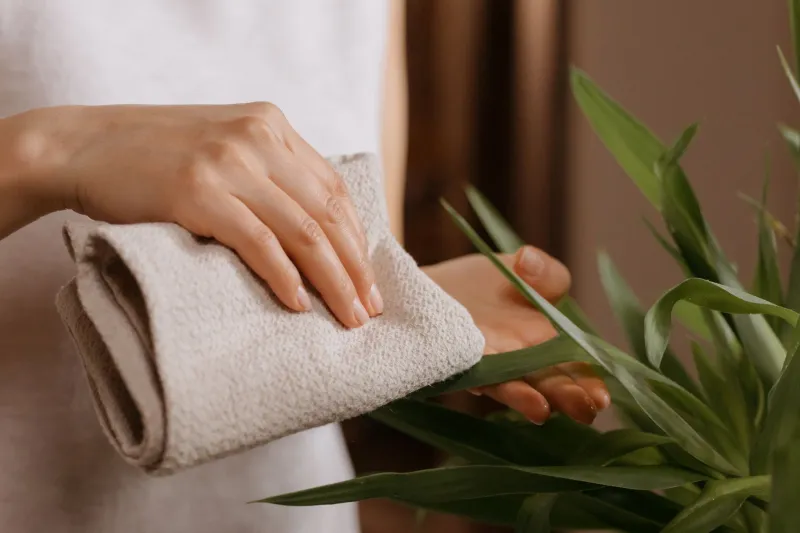
The equipment should be modest and soft. A small, dry artist's brush — the sort sold for watercolour work — is useful for the undersides and the joins around the crown. A microfibre cloth, reserved for plants and washed without fabric conditioner, is the main instrument. A second cloth, dry, follows behind. Rainwater or filtered water at room temperature is sufficient for most smooth-leaved orchids; British tap water, particularly in hard-water areas, leaves mineral traces that are best avoided on foliage. A shallow bowl and a towel complete the kit.
What should not be used is equally important. Leaf-shine products, oils, milk washes and proprietary glosses may produce a brief gleam, but they can clog the stomata and attract dust in the days that follow. Nor is there any need for commercial wipes, which often contain surfactants and perfumes. The aim is not a polished show leaf but a clean, breathing surface.
A Leaf-by-Leaf Method
Work in the morning, when any slight dampness will dry before the room cools. Support the leaf from beneath with the flat of the hand; orchid leaves are more brittle than they appear, particularly in dry central heating. Wipe from the base towards the tip, following the line of the leaf, rather than scrubbing across it. Use light pressure. The cloth should lift the dust, not abrade the surface. For the underside, turn the cloth and work gently between the veins, where mites and debris collect. Finish with the dry cloth, passing once along the length of the leaf.
For plants with a central crown, such as Phalaenopsis, take care not to let water pool where the leaves meet. A twisted corner of cloth can be used to draw moisture away. If the plant is in bud or flower, clean only the leaves and leave the inflorescence untouched. The whole exercise, for a single windowsill orchid, should take no more than ten minutes.
Frequency matters. Every two to three weeks is generally sufficient in winter, when windows are closed and dust settles steadily. In summer, when windows are open and the light is stronger, a monthly pass may be enough. Over-cleaning is a real temptation once the habit begins; it is unnecessary and can bruise the leaf surface.
Leaves That Should Be Left Alone
Not every orchid welcomes the cloth. Plants with velvety or hairy foliage — certain Paphiopedilum species, for example — should not be wiped with water, as the texture traps moisture and marks easily. A dry brush is the only suitable tool. New leaves that have not yet hardened should be left until they are firm. Any leaf with a split, a soft brown patch or a recent knock should be allowed to callous before it is handled. And a plant that has just been repotted or moved to a new room is better left to settle for a week or two; cleaning can wait.
The Pleasure of the Finished Plant
There is a particular satisfaction in a clean orchid on a winter sill. The leaf takes on a deeper green, the veining becomes visible, and the plant seems to occupy the room more confidently. It is not a transformation so much as a restoration — the removal of a film that had no business being there. In the low, slanting light of a November afternoon, that difference is quietly legible.
Cultivated living is rarely about grand gestures. It is about the small, repeated acts that keep a plant in good order through the year. A clean leaf in a dim season is one of them: modest, necessary, and — for the grower who notices such things — a genuine pleasure.