The Quiet Collector: Five Understated Orchids for the British Windowsill
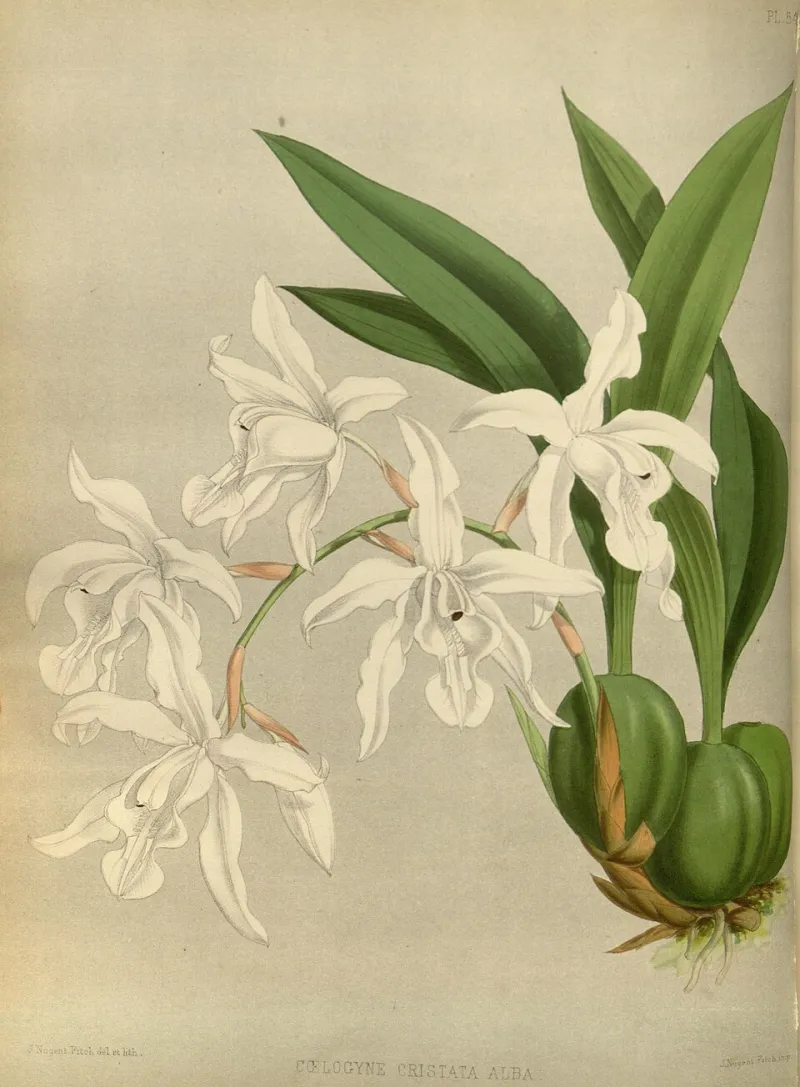
Photo: B. S. Williams,, Public domain, via Wikimedia Commons
The supermarket Phalaenopsis has done much to bring orchids into British homes, but it has also narrowed expectations. For the discerning grower, the pleasure of orchid cultivation often begins when the familiar mass-market hybrid gives way to species with subtler habits and more particular requirements. These are not plants for the impatient. They reward observation, seasonal adjustment and a willingness to learn the small differences between one windowsill and another.
The five orchids considered here are not rare in the manner of specialist exotica, nor are they difficult for their class. They are, rather, quietly distinctive: plants that ask for a little more thought than the average moth orchid and give, in return, a sense of genuine collection. Their needs reflect the British home at its best—bright but not scorching, cool at night, and amenable to the discipline of rainwater and restraint.
Coelogyne cristata: the snow orchid
Coelogyne cristata is among the most elegant of cool-growing orchids. Its white flowers, marked with gold on the lip, appear in late winter and early spring, often in generous sprays. The plant has a relaxed, almost cascading habit, and mature specimens can become substantial. For a British grower, it is well suited to a cool conservatory, a bright spare room or an unheated porch that does not fall below freezing.
Light should be bright but filtered; a little morning sun is welcome, but harsh summer sun should be avoided. During active growth, water freely and feed lightly. In winter, reduce watering as growth slows, but do not allow the pseudobulbs to shrivel. Coelogyne cristata dislikes stale, warm air, so cool nights and good ventilation are important. In a refined interior, it is best displayed at eye level, where the arching flower spikes can be appreciated without being crowded by other plants.
Dendrobium kingianum: the pink rock orchid
Dendrobium kingianum is a tough, adaptable species from eastern Australia, and it has earned a following among British growers for good reason. It is compact, tolerant of cool conditions and capable of producing clusters of pink, sometimes fragrant flowers in late winter and spring. It can be grown in a pot or mounted on cork, though pot culture is more practical in most homes.
The key to flowering is a cool, bright winter rest. During summer, water and feed generously; in winter, reduce water sharply and provide bright light, preferably with cool nights. A cool bedroom or conservatory suits it well. If kept too warm and wet through winter, it may produce growth at the expense of flowers. Its compact habit makes it suitable for a windowsill display, where a simple stoneware pot and a little moss can lend it a quiet, alpine dignity.
Encyclia cochleata: the cockleshell orchid
Encyclia cochleata, sometimes called the cockleshell orchid, is a rewarding species for the intermediate grower. Its flowers are unusual rather than showy: greenish petals surround a dark, shell-like lip, and the plant can flower over a long period. It is not a plant that demands attention, but it rewards close inspection.
It enjoys bright, filtered light and intermediate temperatures. Water should be generous during active growth and reduced slightly in winter, though it does not require a severe rest. Good airflow is important, particularly in humid British summers. The species is well suited to a bright bathroom or kitchen window, where humidity is moderate and light is consistent. Its architectural flowers work well in a simple glass or ceramic container, allowing the unusual form to be seen clearly.
Laelia anceps: the two-edged laelia
Laelia anceps is a cool-to-intermediate species with a long history in cultivation. Its flowers, carried on tall stems in autumn and winter, are distinguished by their narrow, two-edged pseudobulbs and a certain restrained grandeur. It is more tolerant of cool conditions than many showy hybrids, making it a sensible choice for British growers with a bright, unheated room.
Provide bright light and good ventilation. During summer, water freely; in winter, allow a drier rest, though the plant should not be kept bone dry for long periods. Laelia anceps can become large, so it is best given space and a sturdy pot. In an interior, it lends height and structure; a single specimen on a console or in a glazed extension can be more effective than a crowded group.
Pleione formosana: the windowsill pleione
Pleione formosana is a small, seasonal orchid that offers a very different pleasure. It emerges in spring with delicate pink flowers and pleated leaves, then dies back to pseudobulbs. It is well suited to cool British conditions and can be grown on a cool windowsill or in a sheltered alpine frame.
Its cycle is important: keep the compost moist during spring growth, reduce water as the leaves yellow, and keep the pseudobulbs almost dry through winter. Repot regularly in fresh, open compost. Because it is compact and ephemeral, it works beautifully in a shallow pan or stone trough, grouped with moss or small stones. It is a plant for the attentive grower, but its brief flowering is all the more precious for being seasonal.
A collection, not a crowd
These five orchids do not share identical needs, and that is part of their value. They encourage the grower to observe microclimates: the cool corner, the bright shelf, the humid bathroom, the airy porch. In a refined interior, they are best displayed according to those needs rather than arranged purely for colour. Simple pots, good light and a little restraint will do more for them than elaborate decoration.
The quiet collector’s reward is not the instant impact of a supermarket display but the slower satisfaction of plants that reflect their seasons. In a British home, where light and temperature shift markedly through the year, such orchids become companions to the calendar. They ask for attention, but they give back a calm and distinctive beauty that is entirely their own.